
TOPICS:
When Death Pauses
Feb 06, 2026 / Written by: Tonia Long
What Incorruptible Saints Reveal About God’s Mercy
What if you were confronted with bodies that refused to rot?
What if they were not found in a book of legends or in exaggerated medieval tales whispered by candlelight? But these were the bodies of real men and women with documented deaths, recorded funerals and verified exhumations—sometimes decades or centuries later.
Throughout history, the Catholic Church has encountered a rare and mysterious phenomenon known as incorruption: the preservation of a body after death beyond what natural causes would normally allow. These cases are not presumed to be miraculous by default. They are investigated cautiously, documented soberly and approached with theological restraint.
Yet again and again, the same unsettling fact remains. While most bodies decay as expected, some do not.
The Church does not teach that incorruption guarantees holiness or that every saint will experience it. Rather, when it occurs, incorruption serves as a sign—not glorifying the body itself, but pointing to the action of God’s grace in a life totally surrendered to Him.
The following five saints span nearly four centuries of Church history. They differed in vocation, personality, geography, charism and suffering. Yet all belonged to God without reserve—and in death, their bodies bore silent witness to that belonging.
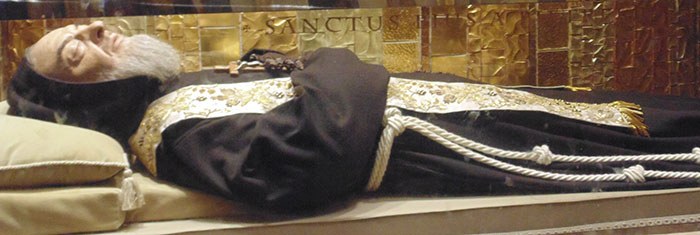
Saint Padre Pio (Feast Day: September 23)
For more about Saint Padre Pio, click here
Padre Pio’s death is recent enough to challenge modern assumptions.
He did not die in an era of primitive medicine or incomplete records. He died in 1968, in the age of antibiotics, clinical pathology and forensic documentation.
Decades after his death, when his body was exhumed and later transferred for public veneration, physicians noted something extraordinary: his body had not undergone the level of decomposition normally expected after so many years.
His facial features were still recognizable. His hands—those hands that bore the wounds of Christ’s Passion for nearly fifty years—remained intact. While later conservation measures were applied, the initial state of preservation defied expectations.
During his lifetime, Padre Pio spent more than half a century in the confessional, absorbing the weight of human sin, enduring profound interior suffering and submitting humbly to intense ecclesiastical scrutiny.
Even decades after death, his body continues to proclaim what his life preached relentlessly: union with the Crucified Christ leaves an indelible mark.
Mother Mariana of Jesus Torres (Feast Day: February 2)
For more about Mother Mariana of Jesus Torres, click here

Traveling backward in time, we encounter a woman whose body waited nearly two centuries to give its testimony.
Mother Mariana of Jesus Torres died in 1635 in Quito, Ecuador. When her body was exhumed almost 200 years later, witnesses—including clergy and medical observers—were astonished.
Her flesh was preserved. Her facial features were peaceful. Most striking of all, her heart was found incorrupt, completely unscathed by the passing of time.
Mother Mariana was not a cloistered mystic shielded from suffering. She endured severe physical illness, demonic assaults, and supernatural trials permitted by God for the sake of future generations.
Through the apparitions of Our Lady of Good Success, Mother Mariana was shown a time when faith would grow cold, moral corruption would spread and the priesthood would suffer deeply—warnings that resonate powerfully in the modern era.
Her incorrupt body remained hidden until history itself began to echo the message Our Lady revealed to her in her lifetime about ours.
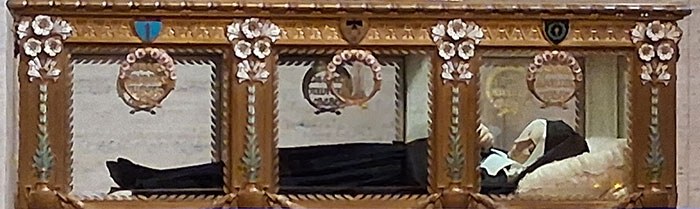
Saint Bernadette Soubirous (Feast Day: April 16)
For more about Saint Bernadette Soubirous, click here
Few cases of incorruption are as thoroughly documented as that of Saint Bernadette.
Bernadette died at just 35 years old, worn down by illness and exhaustion. Yet her body was exhumed not once, but three times—in 1909, 1919 and 1925.
That is 30, 40, and 46 years after her death.
Each examination recorded the same findings:
- Her body was remarkably preserved
- Her skin retained elasticity
- Her joints remained flexible
- Her expression was serene
No embalming had been performed.
Saint Bernadette, who saw Our Lady of the Immaculate Conception in 1858, spent the rest of her life misunderstood, hidden and physically broken. The same girl who opened up a miraculous spring under the direction of the Queen of Heaven spent her final years suffering from the painful, fatal tuberculosis of the bone. She never sought attention, never sought validation and never sought relief from her suffering.
Her incorruption teaches a quiet but piercing lesson: God does not reward exhibition. He rewards fidelity.
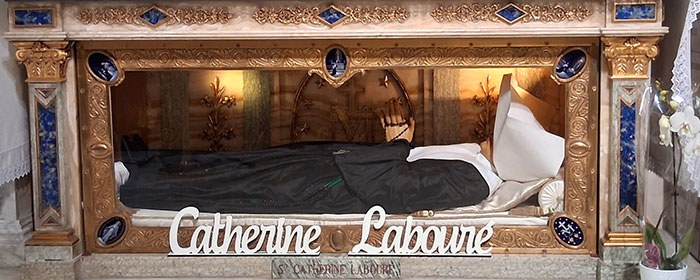
Saint Catherine Labouré (Feast Day: November 28)
For more about Saint Catherine Laboure, click here
Saint Catherine Labouré lived—and died—in obscurity.
She never publicly revealed herself as the visionary of the Miraculous Medal. She sought no recognition, no authority, no spiritual prestige.
When her body was exhumed in 1933, 57 years after her death, it was found incorrupt.
Her eyes were clear. Her features calm. Her body intact.
This is the woman to whom Our Lady entrusted a simple but profound promise: “Those who wear this medal with confidence will receive great graces.”
In life, Catherine fulfilled her mission silently. In death, her body reflected that same quiet obedience—testifying that humility does not diminish holiness; it magnifies it.
Saint John Vianney (Feast Day: August 4)
For more about Saint John Vianney, click here
Finally, we meet a priest whose body continues to instruct the Church centuries later.
Saint John Vianney died in 1859, physically exhausted by fasting, penance and sixteen-hour days in the confessional. He offered himself so completely for souls that his own body was treated as an afterthought.
More than 50 years after his death, his body was exhumed and found in a striking state of preservation.
The Curé of Ars once said, “The priesthood is the love of the Heart of Jesus.”
Even in death, his incorrupt body echoes that truth—quietly affirming the dignity, sacrifice and supernatural weight of the priestly vocation.
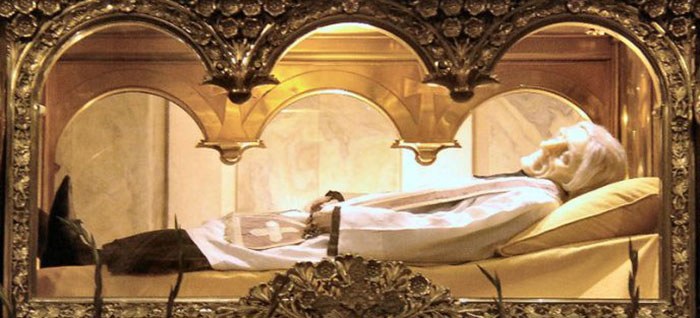
Saint Vincent de Paul (Feast Day: September 27)
A Saint of Charity Preserved
When pilgrims visit the Chapel of Saint Vincent de Paul in Paris (Rue de Sèvres), they often assume they are looking at a statue. In reality, they are gazing upon the actual remains of the saint—preserved for more than three and a half centuries.
Born in 1581 in France, Saint Vincent de Paul became one of the greatest apostles of charity the world has ever known. He founded the Congregation of the Mission (the Vincentians) and, alongside St. Louise de Marillac, the Daughters of Charity. His life was poured out for the poor, the sick, abandoned children and galley slaves.
St. Vincent died on September 27, 1660.
His body was first exhumed in 1712 and again in 1737—52 and 77 years, respectively, after his burial—as part of the canonical investigation for his beatification.
Witnesses recorded that:
- The body was found largely intact.
- The eyes were still present.
- The flesh retained flexibility.
- No significant odor of decay was reported.
Another fascinating detail: St. Vincent’s heart was removed and preserved separately as a relic. It, too, is incorrupt. It is kept in a reliquary and venerated independently.
This was not uncommon among saints of major importance in earlier centuries. The heart symbolized the center of charity—particularly fitting for a man known as the “Apostle of Charity.”
Why would God preserve the body of a man whose entire life was hidden in humble service?
Perhaps because St. Vincent preached something radical: that love of Christ must be visible in love of the poor. His preserved body silently proclaims that what is done for Christ does not decay. Charity endures.
In a secular France that would soon descend into revolution, Vincent’s incorruptibility stood as a prophetic sign: The Catholic Faith cannot be destroyed, not even by revolutions and heresies.
For more about St. Vincent de Paul, click here
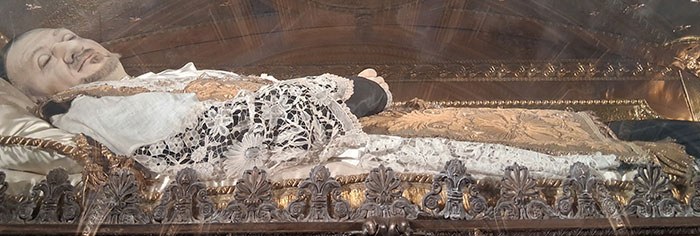
A Modern Sign in Missouri: Sister Wilhelmina
Now move forward more than 350 years and across an ocean—from France to rural Missouri.
Sr. Wilhelmina (Lancaster) of the Most Holy Rosary was born in St. Louis in 1924. She founded the Benedictines of Mary, Queen of Apostles, in Gower, Missouri—a community devoted to traditional Benedictine life, reverent liturgy and Marian devotion.
She died on May 29, 2019, at the age of 95.
There was nothing extraordinary about her burial. She was laid in the ground in a simple wooden coffin. No embalming. No vault. In fact, there was even a puddle of water at the bottom of her grave.
Four years later, in preparation for moving her remains into the church—a common practice for founders of religious communities—the sisters exhumed her body on April 28, the Feast of St. Louis de Montfort.
What they discovered stunned them.
Despite standing water, dirt, a collapsed coffin lid and four years in the earth, Sister Wilhelmina’s body was found in a remarkably preserved condition. Dirt had penetrated the coffin and lay over her remains. Yet her body was intact.
Even more striking:
- Her crown and bouquet were dried in place.
- Her profession candle, ribbon, crucifix and rosary remained intact.
- Her religious habit—made from natural fibers, which she had defended vigorously throughout her life—was preserved.
- Meanwhile, the synthetic coffin lining material had completely deteriorated.
As the sisters gently cleaned the remains, natural changes occurred with exposure to air. Some shrinking and darkening followed. Because dirt had caused facial damage, especially to her right eye, a wax mask was carefully crafted for protection. Her hands were also covered with wax.
But the fact remained: four years in wet earth without embalming, and her body did not decay in the expected manner.
News spread rapidly. Pilgrims began arriving in Gower, Missouri. The faithful knelt in silence before a sign that seemed to softly proclaim: holiness is real. Heaven is real. The body matters.
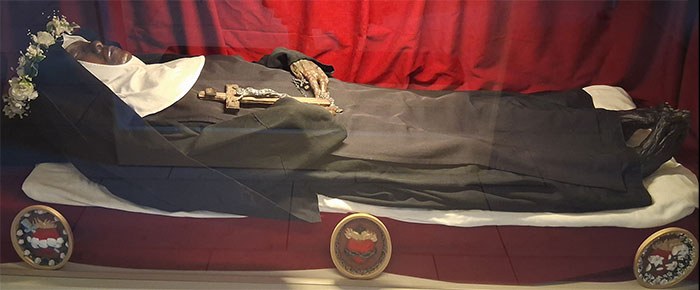
A Foretaste of the Resurrection and Eternal Hope
These seven saints lived in different centuries, cultures, continents and circumstances. Yet they share one essential trait: they belonged entirely to God.
Their incorrupt bodies are not mere scientific curiosities. They are signposts—reminders that grace is real, holiness is costly and God is not indifferent to how we choose to live out the gift of life He has given us.
We live in a culture that often treats the body as disposable—through abortion, euthanasia, commodification, and confusion about human identity.
Catholicism is not a religion that despises the body. The Incarnation—God taking on flesh in Jesus Christ—reveals the dignity of the human body. Christ rose bodily from the tomb. At the end of time, we too will rise.
When a saint’s body resists corruption, it becomes a visible sermon on that promise.
Incorrupt saints remind us:
- The body is sacred.
- The body is destined for resurrection.
- What we do in the body matters eternally.
For pilgrims who stand before an incorruptible saint, the experience is not morbid. It is peaceful, prayerful, sobering and serves to make sense out of the inevitable – suffering and death.
And with this, there is a stillness that settles over the heart.
Death does not have the final word.
For more information about Incorrupt saints, we recommend the book: The Incorruptibles by Joan Carroll Cruz.
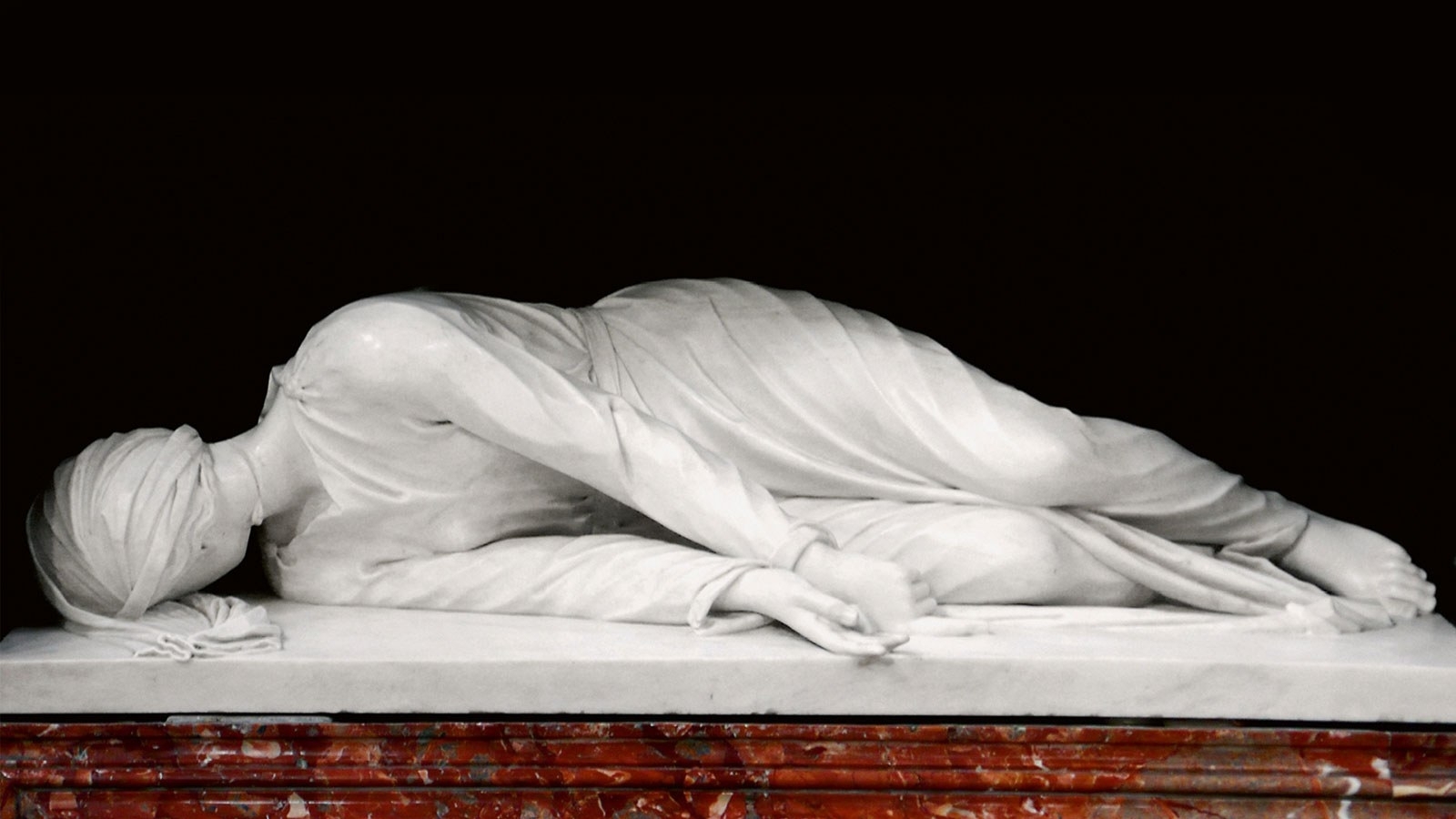
Header image: Sculpture of Saint Cecilia. Saint Cecilia (d. 177 CE) is thought to be the first incorruptible. Her body was disinterred in 822 CE and moved to a cathedral dedicated to her memory. She was exhumed again in 1599 during a restoration of the basilica. Workers discovered her white marble sarcophagi, and when it was opened, "the mortal remains were found in the same position in which the Saint had died almost fifteen hundred years before."


